

Many healthcare organizations report that traditional worklist systems rely on rigid rules that ignore critical context, radiologist specialization, current workload, fatigue levels, and case complexity. This creates a persistent challenge: radiologists cherry-pick easier, higher-value cases while avoiding complex studies, leading to diagnostic delays and increased costs. Research across 62 hospitals analyzing 2.2 million studies found that inefficient case assignment causes 17.7-minute delays for expedited cases and costs of $2.1M–$4.2M across hospital networks. The root cause is straightforward: traditional radiology worklist systems rely on rigid, rule-based engines that ignore the context that matters most — radiologist specialization, current workload, fatigue levels, and case complexity. In this post, we’ll show how to build an radiology workflow optimization with AI agents on Amazon Bedrock AgentCore and Strands Agents SDK .
Radiologist worklist systems rely on deterministic, rule-based engines that route studies according to predefined logic. Static specialty matching ignores context, such as whether the available radiologist has been interpreting complex cases for several consecutive hours or whether a straightforward follow-up scan truly warrants subspecialist attention. Workload balancing responds to current queue depth rather than anticipating demands based on case complexity, estimated interpretation time, or physician fatigue patterns. Most critically, no learning occurs when deterministic rules produce suboptimal assignments, the same inefficient patterns repeat until someone manually updates the underlying logic. In this post, you can learn how to:
- Reduce diagnostic delays by building an intelligent worklist system
- Deploy AI agents that reason about your team’s specialization, workload, and fatigue
- Implement context-aware case assignment that reduces diagnostic delays
By moving beyond rigid, deterministic rules toward Agentic AI that truly understands our subspecialties, we are witnessing a paradigm shift that elevates radiology workflow from simple task management to truly autonomous orchestration. The right subspecialist is seamlessly matched with the right case at the right time, freeing radiologists to focus entirely on diagnostic excellence rather than navigating the queue. Radiology Partners recognizes this as a mission-critical workflow capability and is partnering with AWS to adopt Agentic AI for intelligent workflow optimization.
Agentic AI approach
An AI agent is an autonomous software component that can perceive its environment, reason about goals, and take actions to achieve them. In your radiology workflow optimization, a network of specialized AI agents collaborates to orchestrate complex clinical workflows from start to finish. Each agent handles specific tasks within the workflow. Agents coordinate across specialties and adapt to deliver optimal outcomes for patients and team. AI agents on Bedrock AgentCore evaluate multiple factors simultaneously such as radiologist specialization, current workload, fatigue patterns, case complexity, clinical urgency, and availability to make optimal case assignments. The AI models powering the agents are foundation models (FMs) available through Amazon Bedrock. The system continuously learns from historical patterns and adapts to changing conditions, minimizing the incentive structures that drive cherry-picking behavior.
Overview of the solution
This section walks you through the solution architecture and implementation of accelerating radiology imaging workflows by intelligently optimizing exam prioritization and radiologist assignment. A sample exam assignment output from the intelligent worklist orchestrator is shown in the following figure. A knee MRI study arrives in picture archiving and communication system (PACS) and needs to be assigned. The agentic worklist optimization system suggests the primary assignment along with rationale as below.
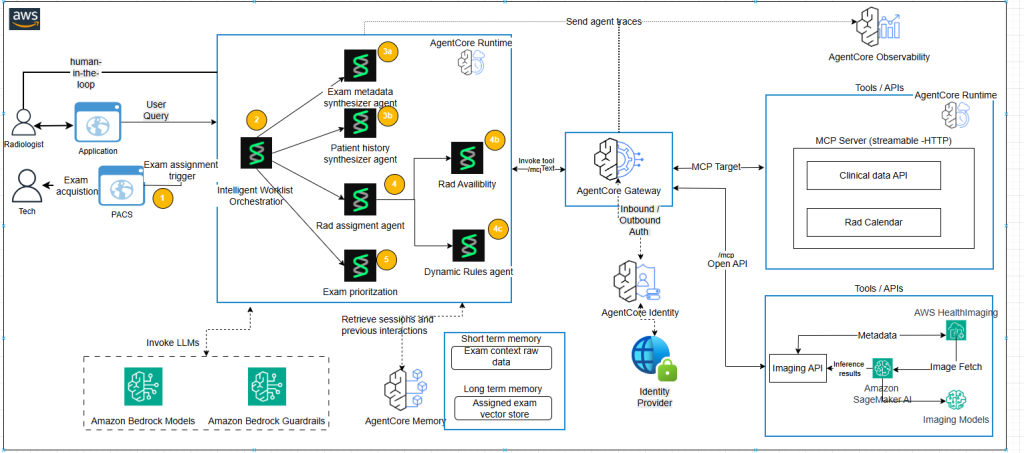
The solution architecture shows components described in the following sections.
-
- The workflow is initiated when a technologist acquires a new exam that becomes available in the picture archiving and communication system (PACS) for reading. A queue of exams verified by technologists for image quality await assignment to the best available radiologist. The assignment process operates as an asynchronous workflow, where exam-to-radiologist matching triggers based on dynamic rules. The goal of the system is to assign the right radiologist to the right exam at the right time.
- The exam assignment trigger initiates AgentCore Runtime session by calling Intelligent worklist orchestration agent (2), which represents the brain of the solution. The orchestration agent is responsible for coordinating multiple specialized AI agents that execute their respective tasks in parallel. For routine workflows, the orchestrator first coordinates with two agents, the Exam Metadata Synthesizer and Patient History Synthesizer to collect relevant contextual information. Based on this aggregated data, the Rad Assignment Agent applies reasoning logic to match the exam with the optimal radiologist. For priority cases, triaging systems identify critical findings requiring immediate attention. When AI algorithms detect urgent conditions such as intracranial hemorrhage, they automatically trigger exam prioritization, prompting the orchestrator to flag a high-priority indicator for the reading radiologist. The agents are hosted on AgentCore Runtime, using the AgentCore Runtime starter toolkit, the AgentCore SDK or directly through AWS SDKs.
- Amazon Bedrock Guardrails is applied at two points in the worklist flow. On the inbound side, it intercepts queries before they reach the Worklist orchestrator, rejecting prompts that attempt to extract patient personally identifiable information (PII), such as names, SSNs, addresses from the clinical data stores. On the outbound side, it scans agent responses from the Exam metadata, Clinical data history, Rad mapper, Exam prioritization and Dynamic rules agents to redact PII that may have surfaced during retrieval from AgentCore Memory or the Clinical data API. This way, agents internally operate on full exam-level data for accurate optimization, but only surface operationally relevant information (exam type, modality, urgency, scheduling) back to the user. Topic restrictions further constrain agents to worklist optimization queries only.
- The Exam metadata synthesizer agent (3a) extracts exam details including modality, body part, and urgency flags from incoming studies. Concurrently, the Patient history synthesizer agent (3b) gathers relevant clinical context and retrieves prior examination records to provide comprehensive patient background information that informs prioritization decisions.
- The Rad Assignment Agent (4) optimizes radiologist allocation for each examination by analyzing multiple factors including radiologist profiles, roles, specialties, preferred hospital affiliations, real-time availability, and dynamic business rules. The agent intelligently balances the worklist by matching each study to the radiologist whose specialization aligns with the exam type, prioritizing STAT cases to meet urgent requirements, and distributing a healthy mix of complex and routine studies to prevent fatigue. Future enhancements can enable the agent to route studies based on their originating hospital and corresponding Service level agreement (SLA) turnaround time requirements.
- The Rad availability sub agent (4a) checks real-time schedules and current workload distribution to balance case allocation. Additionally, the Dynamic rules agent (4b) applies essential business logic including service level agreement requirements, new modalities and exam types, and escalation policies for compliance with institutional and contractual obligations. The agent will also use unstructured notes from the technologist in decision making for matching.
- AgentCore Memory maintains contextual information for exam processing through two complementary memory systems:
- Short-term Memory stores raw interactions to preserve context within individual sessions. It captures the complete conversation history as sequential events, with each exam metadata entry and agent response saved separately. This architecture helps the agent to reconstruct the entire conversation history, maintaining continuity even after service restarts or exam reprioritization triggers. When an assigned exam fails to meet its service level agreement (SLA), a trigger notifies the orchestrator to initiate the reassignment. The system retrieves exam metadata from short-term memory context and invokes only the radiologist availability agent. Similarly, when an assigned radiologist rejects or skips an exam, the reassignment process is automatically triggered based on short-term memory context for accelerated assignment.
- Long-term memory provides persistent knowledge retention across multiple sessions using a semantic memory strategy. The system extracts and stores key information about exam assignments, including Order MRN (Medical Record Number) and assigned radiologist, procedure type and imaging modality, patient clinical history, assignment rationale, and decision factors. This persistent knowledge base maintains a comprehensive radiologist assignment history, which helps the system learn from past decisions and optimize future exam distributions based on historical patterns, radiologist expertise, and workload balancing. While semantic memory retains facts, AgentCore’s episodic memory captures experience-level knowledge: the goals attempted, reasoning steps, actions taken (including tools used and context or parameters passed), outcomes, and reflections of the outcomes. Instead of storing every raw event, it identifies important moments like SLA breaches or assignment rejections by radiologists, summarizes them into compact records, and organizes them so the system will retrieve what matters without noise. Reflections transform episodic experiences into strategic knowledge by identifying patterns, extracting insights, and synthesizing actionable guidance that helps agents to learn and make increasingly informed decisions over time.
- Exam prioritization agent (5) will triage the exams using imaging models that identify the need to increase the priority of an exam based on a critical finding like acute pulmonary embolism, a condition that needs immediate attention to optimize clinical outcomes. This asynchronous workflow processes images through AI imaging models such as Artery-aware network (AANet) for pulmonary embolism detection in CT pulmonary angiography (CTPA) images. When models detect critical findings with high confidence, they automatically trigger study prioritization for immediate radiologist review.
- Once the exam is assigned to a radiologist, they can interact with an intelligent front-end workflow management application that makes the workflow optimization accessible through a user-friendly interface. The radiologist can accept, reject, or skip the assignment and proceed with reading. The radiologist’s choices are automatically learned by the system to improve over time. For example, continuous adaptive learning by analyzing feedback loops and contextual judgment, the agentic system refines case distribution in real-time, reducing the cognitive load on radiologists. Episodic memory strategy reflections built on episodic records like SLA breach, assignment rejection help analyze past episodes to surface insights, patterns, and higher-level conclusions. Instead of simply retrieving what happened, reflections help the system understand why certain events matter and how they should influence future behavior.
- When agents require external data to complete their tasks, they invoke tools via the /mcp endpoint through the AgentCore Gateway. This gateway serves as the central integration hub for the entire architecture, handling Model Context Protocol (MCP) routing along with inbound and outbound authentication for system communications. The gateway connects to AgentCore Identity, which integrates with external identity providers for secure access control across system interactions and data exchanges.
Tool requests are routed to the MCP Server within the AgentCore Runtime, which exposes multiple backend tools essential to the workflow. These integrated tools include access to Clinical data API for accessing patient records and medical histories from electronic health record (EHR) systems and the Rad calendar for retrieving radiologist scheduling information through MCP server. The tools will use existing enterprise Imaging APIs for direct imaging study access from PACS via OpenAPI specifications.
Implementation steps
The following steps are needed to implement the solution. For the full code, see the GitHub repository.
- The intelligent worklist orchestrator agent uses the agent-as-tool pattern and has access to four Strands tools as sub-agent. The orchestrator agent determines which specialized “tool-agent” is best suited for a sub-task. It then “calls” that agent as if it were a function. When called, the sub-agent takes over the sub-task. It uses its own large language model (LLM) and prompt to reason through the problem, calling its own tools multiple times before returning a synthesized result to the orchestrator. The agent uses its built-in MCP client to initiate communication to the right tools through the AgentCore Gateway. This allows the agent to execute complex tasks autonomously by using these tools for real-world action for matching radiologists based on their specialties, retrieving patient medical history, extracting exam metadata, and checking their shifts. This agent uses the following system prompt:
- The MCP server uses FastMCP with stateless HTTP transport, exposing tools decorated with @mcp.tool() that provide radiologist search, imaging study metadata, patient clinical data, and shift availability. These MCP tools are accessed by agents through the AgentCore Gateway to retrieve relevant data. Rad calendar MCP tool finds radiologists’ shifts and real-time schedules from healthcare scheduling systems for the radiologist availability sub-agent. Similarly, the clinical data MCP tool can find the patient’s historical clinical data for the patient history synthesizer agent.
- The following sub-agents are created.
- First is Rad assignment agent (rad_mapper) that matches radiologists based on facility, site, disease, subspecialty, patient historical health data, clinical notes, and other medical parameters, then categorizes them by priority and answers questions about radiologist details.
- Second is the Patient history synthesizer agent (clinical_data_collector) that retrieves patient medical history and identifies relevant historical information for radiologist assignment.
- Third is an Exam metadata synthesizer agent (metadata_finder) that extracts metadata from the current medical imaging study to provide context (anatomy, notes, exam details) for radiologist assignment.
- Fourth is the Rad availability agent (shift_checker), which verifies radiologist availability and selects the best available radiologist from the filtered list by checking their schedules, current workload, and exceptions. The list is filtered by clinical data collector, metadata finder, and rad_mapper sub-agents.
- Through the AgentCore Gateway, agents are provided access to PACS/Imaging API for querying exam metadata. AWS HealthImaging provides the cloud-native medical imaging repository, storing petabytes of DICOM images with sub-second retrieval speeds. It provides the exam metadata synthesizer agent with access to imaging study metadata including patient history, modality type, body parts examined, and urgency levels.
- The solution uses Amazon SageMaker AI to perform real-time inference on machine learning models that detect acute, time-sensitive conditions such as pulmonary embolism. These models analyze medical images stored in AWS HealthImaging and detect key findings that warrant immediate exam reprioritization. Inference results are returned via the PACS/Imaging API to the agents such as the exam prioritization agent, which dynamically adjusts worklist ordering based on clinical urgency.
- In this solution, AgentCore Observability is used to trace the full execution path when a query flows through the Intelligent worklist orchestrator and fans out to the Exam metadata, Clinical data history, Rad mapper, Rad shift checker, and Dynamic rules agents. Each agent invocation is captured as a trace with individual spans, so when an exam assignment request takes longer than expected, it can pinpoint whether the bottleneck was in the Clinical data API call via MCP Gateway, a slow memory retrieval from AgentCore Memory, or the LLM inference itself. The Trajectory view shown here visualizes this end-to-end span chain for a single worklist query, making it straightforward to debug issues like a Rad shift checker agent failing to retrieve calendar data or the orchestrator routing to the wrong sub-agent. These traces feed into Amazon CloudWatch dashboards that track per-agent latency, tool invocation success rates, token consumption, and memory read/write patterns. This provides the operations team the signals they need to tune agent performance and catch regressions before they impact worklist throughput.

Cleanup
The code and instructions to set up and clean up this solution are available in the Intelligent radiology workflow optimization GitHub repo.
Conclusion
In this post, we showed how moving your radiology worklist management from rigid, rule-based systems to intelligent, agent-driven orchestration gives your organization a practical path to reducing operational inefficiencies and protecting your clinicians from burnout. The results we have walked through show that your workflows improve not by adding more rules, but by deploying systems capable of genuine reasoning, contextual judgment, and continuous adaptation. You can extend this solution further to increase its value. By analyzing exam volume and complexity patterns, your agents can identify workflow bottlenecks before they become backlogs, enabling proactive scheduling adjustments such as bringing in additional radiologists early, precisely when and where your data shows demand will spike. When you are ready to move forward, start by identifying the highest-impact use cases in your own environment. From there, establish robust integration patterns with your existing clinical systems, and adopt a phased approach that gives your solution the time and data it needs to learn, refine, and continuously improve.
Get started today by contacting your AWS account representative to discuss a pilot implementation. To learn more, speak with your AWS account team.
About the authors


