

# Introduction to Claude Cowork
Most people who use Claude like a smarter search engine. Type something in, read the response, copy it somewhere useful, then come back and do it again. That loop works fine for quick questions. It does not work for the kind of deep, file-heavy, multi-step knowledge work that actually takes up most of a professional’s day.
Cowork is built for that second category. It is not a new chat interface. It is an autonomous agent that lives inside the Claude Desktop app, has direct access to a folder on your computer, and can plan, execute, and deliver real work — finished documents, reorganized folders, formatted spreadsheets, synthesized reports — without you shepherding every step. Once you understand that distinction, the rest of this article will make a lot more sense.
The clearest way to put it: chat is asking a colleague a question. Cowork is handing a project to a capable colleague and telling them to come back when it is done.
When you open the Cowork tab inside Claude Desktop, you connect it to a folder on your machine. From that point, Claude can read, edit, and create files inside that folder — Word documents, PowerPoint decks, spreadsheets, PDFs, etc. — without you uploading anything manually or copying outputs back from a browser window. You describe what you need as an outcome. Claude breaks the task into steps, sometimes runs them in parallel using sub-agents, and delivers finished files directly to your folder.
That file-system-level access is what separates Cowork from browser-based AI tools. There is no clipboard in the middle. No reformatting. No “export this as a document.” The output lands where you need it, in the format you need it, ready to open and use.
Cowork is available inside Claude Desktop on macOS (Apple Silicon, M1 or later) and Windows. It is not available on the web version of Claude. According to Anthropic’s official support documentation, it uses the same agentic architecture that powers Claude Code, surfaced in a graphical user interface (GUI) that requires no terminal, no coding, and no technical background.
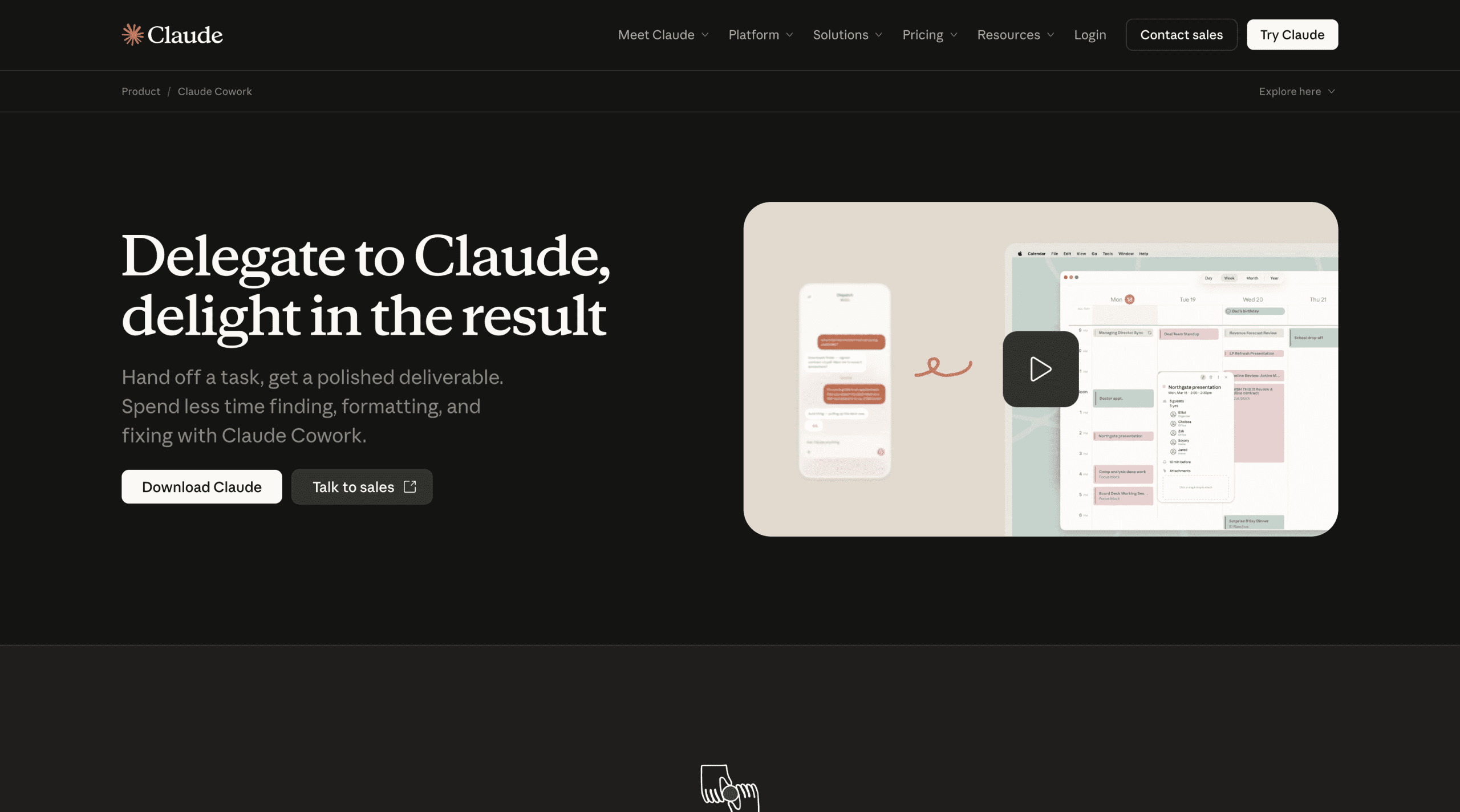
Claude Cowork Desktop app
# Who Should Be Paying Attention
Cowork was designed for non-technical knowledge workers. The target user is not a developer. It is a project manager, a consultant, a researcher, a content lead, a finance analyst — anyone whose job produces a steady stream of documents and whose daily work involves turning raw inputs into structured outputs.
If you regularly find yourself doing things like pulling data from a spreadsheet to write a report, reorganizing folders that have gotten out of hand, synthesizing notes from multiple meetings into one clean document, or preparing slide decks from scattered source material, that is exactly the work Cowork was built to absorb. You describe what you need. Claude plans the work, breaks it into subtasks, executes them, and delivers finished files directly to your folder. You can walk away while it runs.
There are real trade-offs worth understanding before you get started, though. Scheduled tasks in Cowork only run while your machine is awake and Claude Desktop is open. If your machine is off during a scheduled run, the task gets skipped and auto-runs when you reopen the app. If you need tasks to run in the cloud while your laptop is closed, that is a Claude Code feature, not a Cowork one.
# Downloading, Installing, and Setting Up
// Checking Your Plan
Cowork is available on paid Claude plans only. It is available on Pro ($20/mo), Max ($100& – $200/mo), Team ($30/user/mo), and Enterprise. It is not available on the free tier. If you are on Pro, keep in mind that Cowork tasks are more compute-intensive than standard chat, so complex tasks will consume your usage allocation faster. Batching related work into single sessions helps.
// Downloading Claude Desktop
Go to claude.com/download and download the version for your operating system. Cowork requires macOS with Apple Silicon (M1 chip or later) or a compatible Windows machine. If you are on Windows and want to check compatibility before downloading, Anthropic provides a readiness check tool — a small program that runs on your machine and tells you whether your computer is ready for Cowork. Once downloaded, install and open the app.
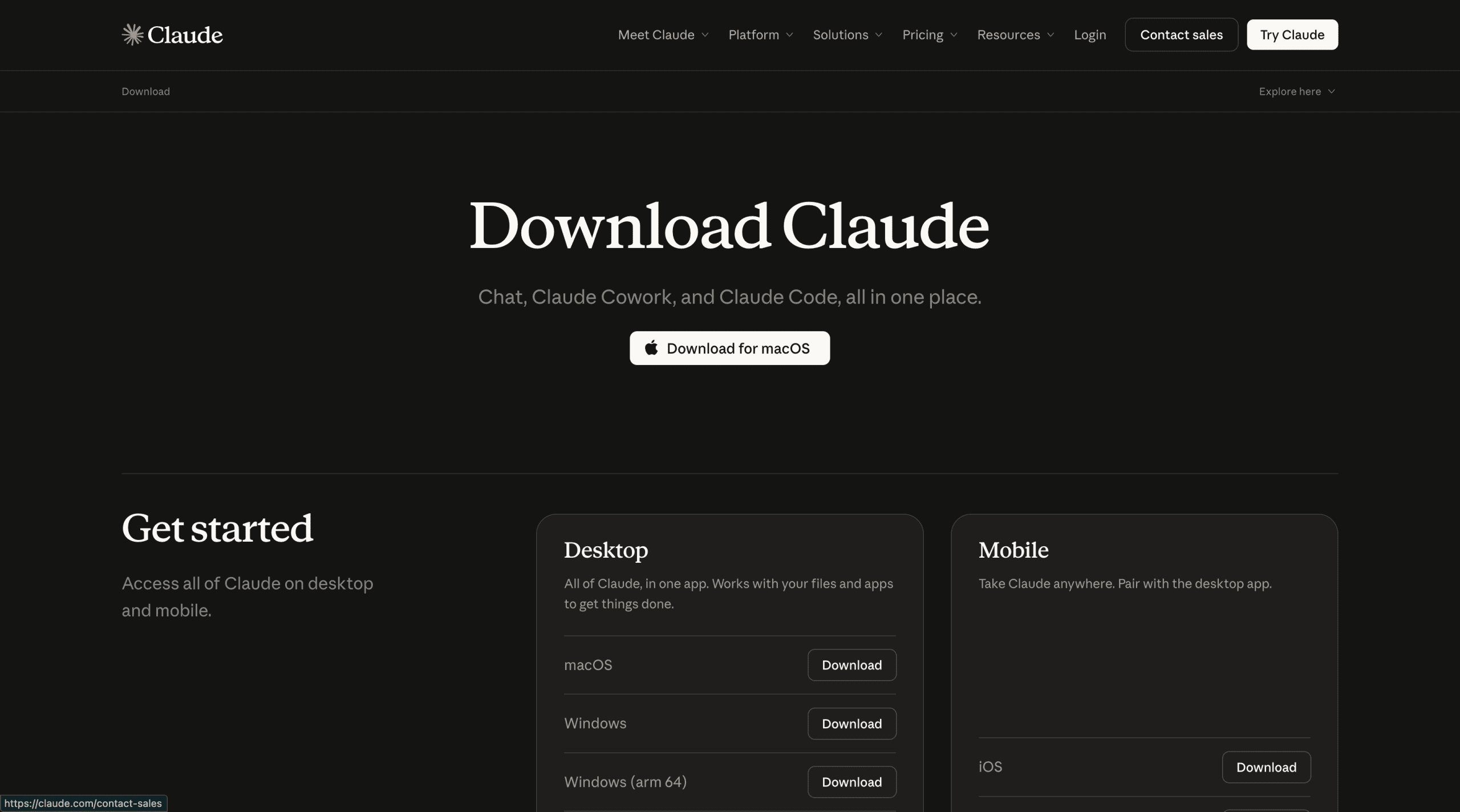
The Claude page showing the macOS and Windows download options side by side
// Finding the Cowork Tab
Once you are inside Claude Desktop, on the sidebar you will see different tabs: Chat, Artifacts, Cowork, and Code. Click Cowork. That switches you into task mode.
// Connecting a Folder
At the bottom of the Cowork interface, click “Work in a Folder.” Select a local folder from your machine. This is the boundary of Claude’s file access — it can only read and write within the folder you select here.
Note: do not start with your live project directory. Create a test folder, drop in some copies of real files you want to process, and run your first few tasks there. It gives you a feel for how Cowork handles your files before you let it near anything critical.
// Setting Your Global Instructions
This step is optional but worth doing before your first real task. Go to Settings > General > Instructions for Claude. Write a short paragraph telling Claude who you are, how you like outputs formatted, and what tone to use. Something like:
“I am a content strategist at a B2B SaaS company. Always format documents with an executive summary at the top, use clear section headers, and write in a concise professional tone. Default output format is Word (.docx) unless I specify otherwise.”
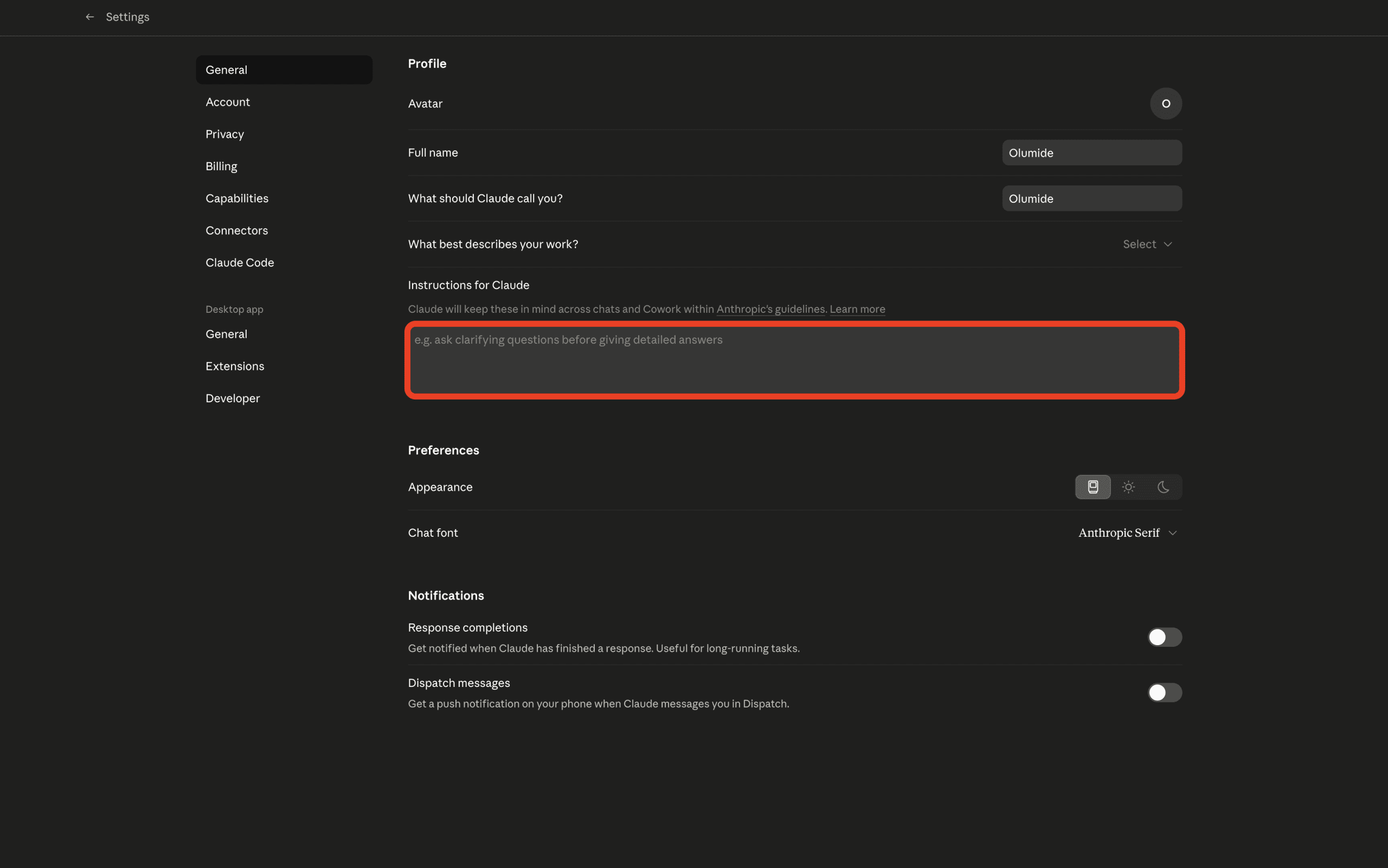
Instructions for Claude
These instructions apply automatically to every Cowork session. You can also set folder-specific instructions that only activate when working in a particular folder — useful if you have separate folders for client work, internal projects, and personal files with different formatting expectations for each.
// Connecting Your Tools
Go to Settings > Connectors. This is where Cowork gets significantly more powerful. Available connectors include Gmail, Google Calendar, Notion, Slack, Microsoft 365 (including Outlook, SharePoint, and OneDrive), and GitHub, among 38+ others. Once connected, your Cowork tasks are not limited to local files. Claude can pull information from your inbox, check your calendar, read Notion pages, and push outputs to the tools your workflow already runs on.
You do not need to connect everything at once. Start with one or two tools that show up in your daily work. The calendar and email connectors alone unlock the morning briefing workflow covered in the next section.
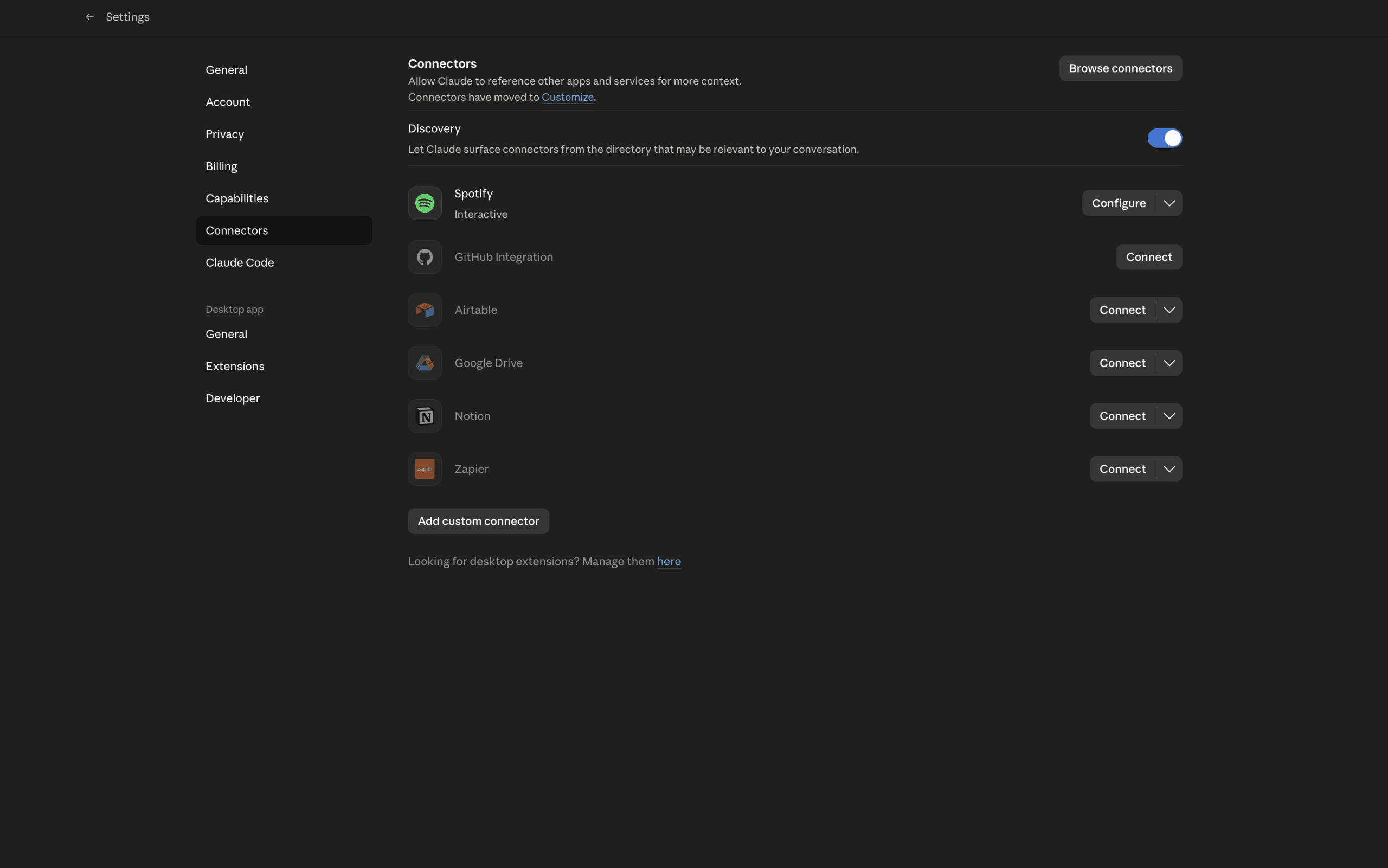
The Connectors panel inside Claude Desktop Settings, showing a grid of available integrations
# Getting the Most Out of Claude Cowork
// Writing Outcome Prompts, Not Instructions
The most common mistake when starting with Cowork is writing prompts the same way you would write a chat prompt — step by step, walking the model through each action. Cowork does not need that. It needs to know what the finished product looks like, not how to get there.
The difference in practice:
Instead of this:
“Open the sales report. Find the revenue column. Add up the numbers by quarter. Then write a paragraph summarizing the trend. Put it in a new document.”
Write this:
“Analyze the Q1 sales report in this folder and produce a Word document with an executive summary, quarterly revenue figures in a table, and a short section on the biggest trends.”
The second version tells Claude what to deliver. It figures out how. Planning alongside Claude before it acts also helps. Before a complex task, ask it what approach it would take and whether your files are in the right format. Review the plan, redirect if needed, then let it run. This prevents wasted runs on tasks that could have been set up better.
// Using Global Instructions to Stop Repeating Yourself
If you find yourself adding the same context to every prompt — your role, your preferred format, your company’s naming conventions — that is a signal to move it into your Global Instructions. You write it once, and it applies to every session going forward.
A few examples of what belongs in a Global Instructions block:
- For a project manager:
“I manage software delivery at a mid-size tech company. When producing reports, always include a status summary at the top (On Track / At Risk / Blocked), use bullet points for action items, and flag any deadlines. Default to .docx for documents and .xlsx for data outputs.”
- For a content writer:
“I am a content writer producing B2B blog posts and long-form guides. My writing style is direct and conversational — no jargon, short paragraphs, no passive voice. Always produce content in Markdown format unless I specify otherwise.”
- For a finance professional:
“I work in financial analysis. When processing data, always include a summary row, flag any outliers in red, and format numbers with commas and two decimal places. Preferred output for data is .xlsx.”
// Scheduling the Work That Repeats Every Week
To schedule a task, type /schedule in any Cowork session. You can also click “Scheduled” in the left sidebar to view, create, and manage your scheduled tasks. Set a cadence — daily, weekly, every Monday morning — and Cowork runs the task automatically on that schedule. The catch: your computer needs to be on, and Claude Desktop needs to be open when the scheduled time hits. If it is not, the task queues and runs the next time you open the app.
Here are three scheduled tasks worth setting up immediately, with the actual prompts to use:
- Morning briefing (runs daily, 8:00 AM — requires Gmail and Google Calendar connectors):
“Check my Google Calendar for today’s meetings and my Gmail for any unread emails from the last 12 hours. Write a morning brief with three sections: today’s schedule, any emails that need a response today, and the top three things I should prioritize. Save it as morning-brief-[today’s date].txt in my Briefings folder.”
- Weekly folder cleanup (runs every Friday, 5:00 PM):
“Scan my Desktop and Downloads folders. List every file older than 7 days, grouped by type: screenshots, PDFs, documents, images, and other. For each group, recommend what to archive, delete, or keep. Save the list as a checklist in my Cleanup folder.”
- Weekly expense processing (runs every Monday, 9:00 AM):
“Process all receipt images in my /Receipts folder from the past 7 days. Extract the vendor name, date, amount, and category from each one. Create a categorized spreadsheet with a total row at the bottom and save it as weekly-expenses-[date range].xlsx.”
// Giving It Rich Context
The more context Claude has, the better the output. This goes beyond just connecting tools. Before handing off a complex task, ask Claude what approach it would recommend and whether the files you have provided are in an optimal format. Plan together, provide feedback on the plan, and guide it toward your intended outcome before anyone takes action.
For recurring work, keep a context file inside your Cowork folder — a plain text or Markdown file that describes the project, the stakeholders, the formatting standards, and any decisions already made. Reference it in your prompts:
“Use the context file in this folder for background on the project. Then draft a project status update based on the notes in /meeting-notes.”
That one habit — maintaining a context file — closes most of the quality gap between a first run and a polished output.
# Prompts That Actually Work in Cowork
These are ready to copy, paste, and adjust to your situation. Each one is written as an outcome prompt — it tells Cowork what to deliver, not how to get there.
- Document creation
“I have three sets of meeting notes in this folder from our Q2 planning sessions. Synthesize them into a single strategy document with these sections: Key decisions made, open questions still to resolve, action items with owner names, and next steps. Format it as a Word document.”
“Read the research papers in this folder and write a 600-word summary of the main findings, the key disagreements between authors, and what the practical implications are. Save it as research-summary.docx.”
- File organization
“Reorganize all files in this folder by year and month based on their creation date. Create subfolders in the format YYYY-MM and move each file into the correct one. Do not delete anything.”
“Look through the documents in this folder and rename each one to follow this format: [YYYY-MM-DD]-[topic]-[document-type]. Use the document contents to figure out the topic and type.”
- Data and reporting
“Analyze the spreadsheet in this folder. Identify the top 10 rows by revenue, calculate month-over-month change for each, and produce a summary report in Word with a table and three bullet points on what the data shows.”
“Process the CSV file in this folder. Clean up any duplicate rows, fix inconsistent formatting in the date column, and save the cleaned version as a new file with ‘-cleaned’ added to the filename.”
- Research and synthesis
“Read all the articles saved as PDFs in this folder. Identify the three most common themes, find where the sources agree and where they contradict each other, and write a 400-word synthesis. Cite which document each point comes from.”
- Presentations
“Using the project brief and the data export in this folder, create a PowerPoint presentation with these slides: Overview (1 slide), Key Findings (2–3 slides), Recommendations (1 slide), Next Steps (1 slide). Keep each slide to one idea. Use the data to support the findings slides.”
- Scheduled automation
“Every Monday at 8:30 AM, check my Google Calendar for the week ahead. For each meeting that has an attached document or a title that suggests preparation is needed, create a brief prep note with the meeting context, what I likely need to know, and two questions I should go in ready to answer. Save all notes as a single file in my /Meeting-Prep folder.”
# Conclusion
Cowork changes the relationship with AI work from interactive to delegated. The chat version of Claude makes you faster at doing things yourself. Cowork actually does the things — starts them, runs them, finishes them, and delivers them to your folder. That is a meaningful difference for anyone whose work produces a lot of documents and not enough time.
The entry point is lower than it looks. Download Claude Desktop, connect one folder, and run one task from the prompts above. That first session — watching Claude plan the work, execute the steps, and drop a finished file into your folder — is usually the moment it clicks. Start there, then build your Global Instructions and your first scheduled task once you have seen what it can do.
Shittu Olumide is a software engineer and technical writer passionate about leveraging cutting-edge technologies to craft compelling narratives, with a keen eye for detail and a knack for simplifying complex concepts. You can also find Shittu on Twitter.


