

Did you know?
As per current data 69% of professionals believe that AI is disrupting their job roles.
However, instead of fear, there is immense optimism; an overwhelming 78% are positive about AI’s potential impact on their careers.
As the demand for artificial intelligence surges globally, many aspiring professionals wonder exactly how much programming expertise is needed to enter this lucrative field.
Do you need to be a coding prodigy to succeed, or are there alternative, low-code pathways? Understanding the basic architecture behind AI and what is LLM (Large Language Model) infrastructure versus general machine learning, is your first crucial step.
This article breaks down the coding requirements across various AI and LLM-related job profiles, highlighting key languages, to help you navigate your career strategy effectively.
Summarize this article with ChatGPT
Get key takeaways & ask questions
Why Coding Matters in AI and LLM Ecosystems?
Despite the rapid rise of low-code platforms and automated tools, programming remains the vital backbone of robust artificial intelligence systems.
According to recent workforce trends, Machine Learning and Artificial Intelligence have emerged as the top domains of choice for upskilling, selected by a massive 44% of professionals.
This high level of interest underscores the underlying need for technical proficiency in the modern enterprise. You must understand that coding plays a pivotal, non-negotiable role in three main operational areas:
- Data Processing and Transformation:
Raw data is messy, unstructured, and rarely ready for model training. Programming is absolutely essential for cleaning datasets, handling missing values, standardizing inputs, and executing feature engineering so that algorithms can process the information effectively without bias or error.
- Model Building and Experimentation:
Developers and researchers rely heavily on code to construct deep neural networks, continuously adjust hyperparameters, and iteratively test different algorithmic architectures. This granular control ensures the model achieves the desired accuracy, precision, and efficiency metrics.
- Deployment and Scaling:
Once a machine learning model is successfully trained, it must be integrated into live production environments. Coding facilitates the creation of secure APIs, robust cloud deployment architectures, and continuous monitoring systems (known as MLOps) to track model drift over time.
Detailed Comparison: Python vs. SQL vs. JavaScript in AI
If you are currently debating should I learn machine learning python or AI tools first, understanding the dominant languages is critical. Below is a detailed comparison table of the top three languages powering the AI and LLM ecosystem:
| Feature / Language | Python (The Dominant Force) | SQL (The Data Handler) | JavaScript (The Interface Builder) |
| Primary Use in AI/LLMs | Core model building, data science, training neural networks, and writing AI backend logic. | Extracting, manipulating, and querying vast amounts of structured data necessary for training. | Building interactive user interfaces, web applications, and frontend integrations for LLM APIs. |
| Coding Complexity | Moderate. Highly readable syntax, making it excellent for beginners and researchers. | Low to Moderate. Declarative language focused strictly on logic and data retrieval. | Moderate to High. Requires understanding of asynchronous programming and web architectures. |
| Key AI Libraries & Frameworks | PyTorch, TensorFlow, Pandas, Scikit-Learn, LangChain, HuggingFace Transformers. | N/A (Relies on database engines like PostgreSQL, MySQL, and emerging Vector DBs like pgvector). | TensorFlow.js, LangChain.js, React, Node.js. |
| Ideal Role Suitability | Machine Learning Engineer, Data Scientist, AI Researcher, AI Backend Engineer | Data Analyst, Data Engineer, Data Scientist. | Full-Stack Developer, AI App Developer, Frontend Engineer |
| LLM Era Impact | Remains the absolute industry standard for LLM agents and pipelines. | Crucial for Retrieval-Augmented Generation (RAG) when fetching enterprise data to feed LLMs. | Increasingly popular for building ChatGPT-like clones, AI chatbots, and browser-based AI tools. |
To build your foundational skills, you can explore the, Artificial Intelligence with Python free course, which helps you learn artificial intelligence concepts specifically utilizing the Python programming language. For visual learning you can watch:
Coding Requirements by Role
1. Data Scientist
- Coding Level: Moderate to High
- Focus:
Data Scientists primarily focus on statistical data analysis, advanced feature engineering, and predictive model building. Their primary objective is to extract actionable business insights from raw data. In fact, current reports show that 39% of professionals actively utilize GenAI specifically for analysing large datasets to accelerate this process.
- Tools:
Data Scientists rely heavily on Python and R, utilizing robust statistical libraries such as Pandas, Scikit-learn, and NumPy. Jupyter notebooks serve as their standard, day-to-day environment for exploratory data analysis. Unlike ML Engineers, there is slightly less focus on strict, production-level software engineering and more emphasis on mathematical and statistical validity.
2. Machine Learning Engineer
- Responsibilities:
Machine Learning Engineers act as the primary architects of core AI systems. They are required to build, train, and heavily optimize complex algorithmic models from the ground up. Furthermore, they must deploy robust data pipelines and manage the entire MLOps lifecycle to ensure these models run seamlessly and cost-effectively in production environments.
- What You Must Know?
Deep, comprehensive expertise in data structures, system design, and most used machine learning algorithms in Python is non-negotiable. You must excel in secure API development, model optimization techniques (like quantization), and managing vast cloud computing resources. Working intimately with heavy frameworks like TensorFlow and PyTorch is standard daily practice.
3. AI Engineer (LLM-Focused Roles)
- Key Tasks:
AI Engineers operating specifically in the LLM era focus less on training massive foundational models from scratch, and more on building applied, AI-powered agents. They spend their time working securely with APIs (from providers like OpenAI, Anthropic, or open-source LLMs hosted on HuggingFace) and executing advanced prompt engineering to build intelligent system wrappers.
- Skills:
This highly in-demand role requires solid Python proficiency coupled with foundational backend web development skills. API integration, handling JSON data structures, and managing complex vector databases are critical day-to-day operations. If you are researching how to start a career in artificial intelligence and machine learning, this application-layer pathway is highly lucrative.
A great way to upskill here is by taking the free course on AI Agent Workflows Using LangGraph, which is tailored to help you learn AI agent workflows specifically using the LangGraph framework.
4 Prompt Engineer / LLM Specialist
- Coding Level: Low to Moderate
- Focus:
This newly emerging role centers entirely on prompt design, systemic testing, and output optimization. The primary goal is to iteratively manipulate the model’s natural language inputs to achieve precise, highly accurate outputs without hallucination.
- Emphasis:
Deep language understanding, specific domain expertise, and logical structuring take absolute precedence over deep programming syntax. The role involves writing only a few lines of code, primarily executing basic API calls to test different prompt variations at scale.
While reading a prompt engineering complete guide is essential, many professionals wonder is prompt engineering enough to secure a job?
The industry reality is that while it serves as an excellent entry point, combining prompt design with basic scripting drastically improves your long-term employability.
To get started immediately, you can take the free course on Prompt Engineering for ChatGPT to systematically learn prompt engineering tailored for ChatGPT.
5 AI Product Manager / Business Roles
- Responsibilities:
AI Product Managers bridge the critical gap between technical engineering teams and non-technical business stakeholders. They are responsible for defining clear AI use cases, managing agile product lifecycles, and measuring the financial ROI of AI implementations.
- Skills:
While writing actual production code is entirely optional, thoroughly understanding the underlying logic, constraints, and architecture of machine learning models is critical to lead these teams effectively. To grasp this strategic business perspective, professionals should explore the premium AI for Business Innovation: From GenAI to PoCs course, which bridges the gap from GenAI concepts to practical Proof of Concepts for business innovation.
6 No-Code / Low-Code AI Roles
- Tools:
Business analysts, marketers, and operational teams are increasingly utilizing AutoML platforms and LLM wrappers. By leveraging powerful, user-friendly tools like LangChain UI, Zapier integrations, and pre-built enterprise AI agents, professionals can automate complex workflows without ever touching a codebase.
- Demand:
There is a massive, growing demand within business units for professionals who can strategically stitch together these no-code AI tools to solve daily operational bottlenecks.
LLM Era Shift: Is Coding Becoming Less Important?
The advent of Large Language Models has fundamentally shifted the technical learning. Today, an impressive 80% of professionals report that they actively use GenAI to learn new skills.
Furthermore, a significant 25% are already utilizing GenAI for auto coding tasks to speed up their development cycles.
This rapid adoption leads to a common, anxious industry question: Do AI coding assistants reduce the need for programmers?.
We are undeniably witnessing the rise of pre-trained foundational models and a heavy industry reliance on APIs instead of building neural networks from scratch.
The corporate has shifted drastically from “build proprietary models” to “integrate existing intelligence.” However, observing how developers adapt to generative AI proves that core engineering roles still require deep, fundamental coding expertise.
While GenAI can generate basic boilerplate code rapidly, highly skilled human programmers are strictly required for
- complex system architecture
- secure data implementation
- debugging intricate
- unpredicted edge cases
The Ultimate Technical Learning Path: From Beginner to AI Specialist
As 81% of professionals are actively planning to pursue upskilling programs in FY2026. However, with 37% of individuals citing demanding office work as their biggest barrier to learning, having a highly structured, time-efficient strategy is non-negotiable.
To successfully navigate this technical transition without wasting your limited bandwidth, you must rely on comprehensive careers and roadmap guides that dictate exactly which skills to prioritize.
Below is a step-by-step, actionable framework to build your technical proficiency from the ground up.
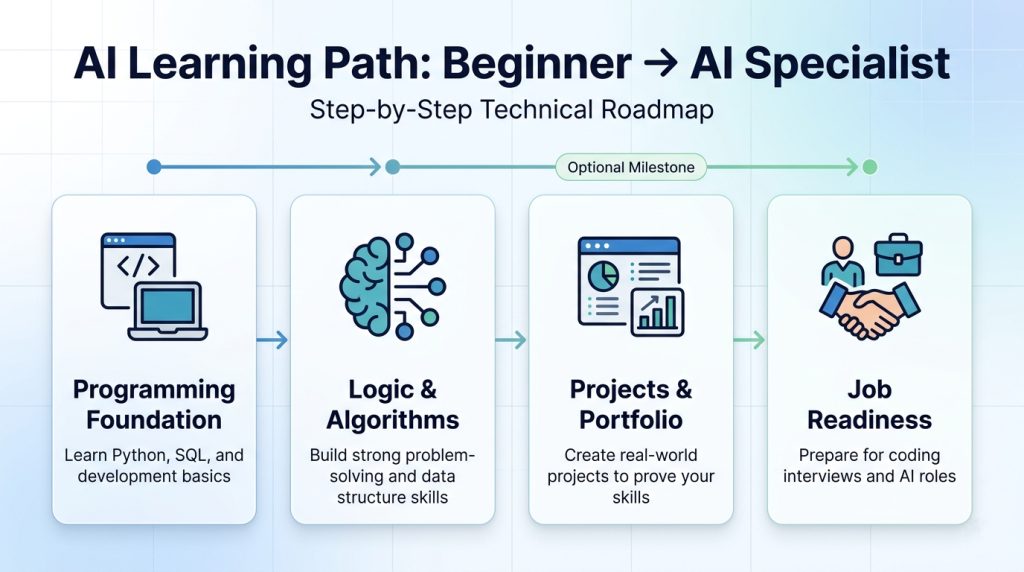
Step 1: Establish Your Core Programming Foundation
You cannot effectively build, train, or integrate advanced AI models without strict fluency in foundational languages.
- Solidify Python and Database Skills:
Python and SQL represent the absolute baseline requirements for the modern data. Engaging with the premium Master Python Programming academy course is the perfect starting point; this premium offering is designed explicitly to help you master Python programming. Concurrently, you must learn to handle data by pursuing the premium Practical SQL Training program, which equips you with strictly practical SQL training.
SQL Course
Master SQL and Database management with this SQL course: Practical training with guided projects, AI support, and expert instructors.
Take SQL Course Now
- Explore Enterprise-Level Alternatives:
For professionals aiming to integrate AI within massive, legacy corporate environments, Java remains highly relevant. You can expand your enterprise backend capabilities by taking the premium Master Java Programming course, which provides a premium pathway to master Java programming.
- Familiarize with Development Environments:
Before writing complex automation scripts, you must deeply understand how to navigate the various tools and compilers required for local environment setup and secure cloud deployments.
Step 2: Master Logic and Algorithmic Thinking
Memorizing syntax will not help you optimize a machine learning pipeline; you must understand how data is organized and manipulated under the hood.
- Study Memory and Structures:
You must learn how algorithms traverse and sort information. Dive into the free academy course on Python Data Structures. This free learning resource is tailored specifically to help you learn Python data structures, a critical competency for reducing compute latency in heavy AI models.
- Commit to Daily Repetition:
Transitioning from passive theoretical learning to active application requires building muscle memory. Consistently working through practical, hands-on coding exercises ensures your scripting logic becomes intuitive and error-free.
Step 3: Execute Projects and Validate Your Competency
Hiring managers in the artificial intelligence space look for tangible proof of your abilities rather than just certificates.
- Build a Public Portfolio:
Do not just follow guided tutorials. Actively seek out complex, industry-relevant project ideas to build your own GitHub repository. Showcasing actual API integrations, data cleaning pipelines, or custom LLM wrappers is the fastest way to prove your competency.
- Benchmark Your Progress:
It is easy to experience the illusion of competence when learning to code. Continuously evaluate your true retention of these complex technical concepts by routinely taking targeted quizzes to identify your blind spots.
Step 4: Prepare for the Technical Job Market
Once your foundational programming logic and portfolio are solidified, you must pivot your focus toward strict employability and interview performance.
- Understand Technical Evaluation Metrics:
AI and ML job evaluations are notoriously rigorous, often involving live coding or system architecture tests. Familiarize yourself with advanced algorithmic interview questions to ensure you can confidently articulate your technical decisions, time complexities, and optimization strategies to senior engineering leads.
If you are looking to formalize your expertise and transition into high-impact technical roles, consider the PG Program in Artificial Intelligence & Machine Learning.
This comprehensive 12-month program, offered in collaboration with Great Lakes and UT Austin, is strategically designed to help you master AI and ML without quitting your job. By offering personalized 1:1 mentorship and providing exclusive access to over 3,000 hiring partners, this program serves as a highly meaningful opportunity to accelerate your career and stand out in the competitive artificial intelligence era.
Real-World Examples
Understanding these varying technical requirements is best illustrated through real-world operational workflows across different corporate departments.
- The Workflow Automator
Consider a marketing specialist who notices their team spends excessive hours summarizing complex market reports. Interestingly, 42% of professionals currently use GenAI to summarise complex information , while an even higher 59% use it primarily for finding new ideas.By utilizing Zapier and the OpenAI API, this specialist can build a highly effective, automated research summarization tool using almost zero code.
Conclusion
The volume of coding required to work successfully in the AI and LLM ecosystem operates on a very broad spectrum, heavily dependent on your specific career and interests.
While deep machine learning engineers must possess master-level, rigorous programming skills, the rapid rise of powerful APIs and low-code platforms has opened the door wide for product managers, prompt engineers, and business analysts to create immense organizational value with minimal coding.
Ultimately, the most critical skill in the modern LLM era is the agility to continuously learn, adapt, and integrate intelligent systems to solve real-world business problems efficiently.


