

Something crazy is happening in the AI development community, and I think we are witnessing the beginning of a major shift in the software industry.
Developers are no longer just vibe coding websites, dashboards, and simple applications. They are attempting to recreate entire commercial software suites, including Adobe Creative Cloud and Microsoft Office.
And the most interesting part? Some of these projects are being built by individual developers using AI coding agents.
Two names in particular have caught my attention: Reverse Engineer Anything (REA) and ArtCraft.
Why Are AI Software Clones Suddenly Going Viral?
We already have free alternatives to commercial software. GIMP competes with Photoshop, Inkscape offers vector graphics editing, and LibreOffice provides alternatives to Word, Excel, and PowerPoint.
But there has always been one major problem: switching costs.
Most alternatives have their own interfaces, shortcuts, and workflows. If you have spent ten years mastering Photoshop, switching to GIMP can feel like learning an entirely different application.
The new generation of AI-built clones is approaching this differently.
Instead of reinventing the experience, developers are attempting to recreate familiar layouts, menus, shortcuts, and functionality.
Imagine opening a free Photoshop alternative and immediately knowing where everything is. No extensive tutorials, no unfamiliar workflow, and potentially no expensive subscription.
That is the promise, although the actual quality and compatibility of these early clones still vary considerably.
REA Is Making Reverse Engineering More Accessible
One of the most exciting projects behind this movement is Reverse Engineer Anything (REA), an AI-powered reverse-engineering toolkit that has already attracted over 130,000 GitHub stars.
Traditionally, reverse engineering required specialized knowledge, complicated tools, and hours of manual work. REA makes the process much easier by connecting AI coding agents like Claude Code, Codex, and Cursor to tools such as Ghidra, Hopper, and IDA.
The idea is simple: provide an application’s binary, and your AI agent can analyze its functions, dependencies, architecture, and internal behavior without access to the original source code.
You can then use those findings to recreate features or develop your own alternative.
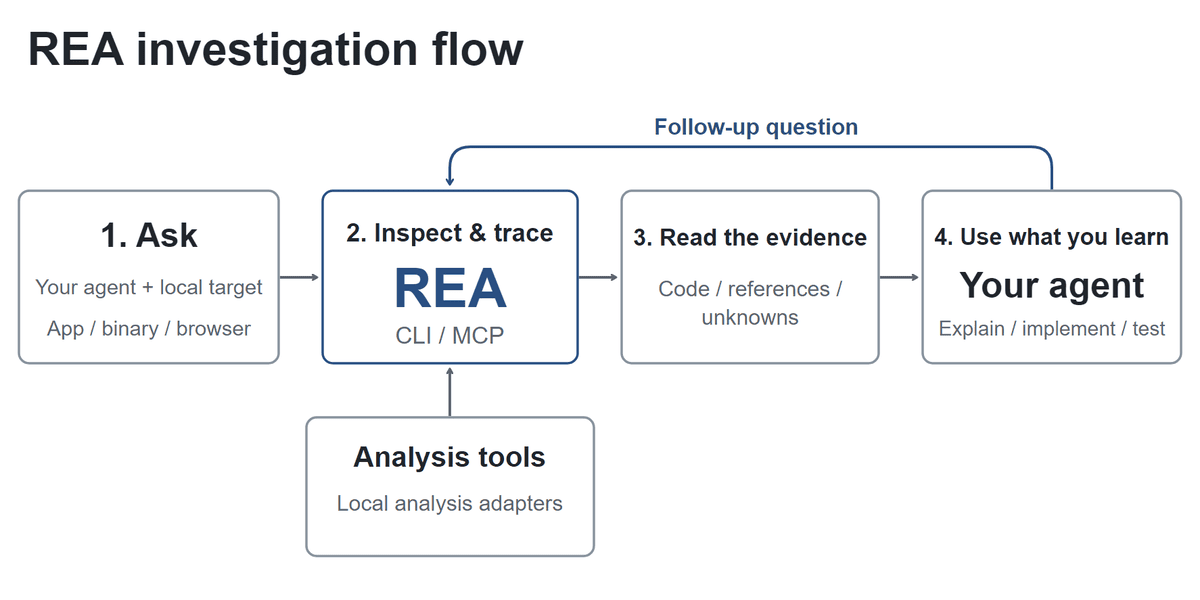
Developers are already experimenting with this approach. REA showcases include reconstructing Notion’s clipboard functionality, recreating sound calculations from DX-Ball, and recovering mathematical routines from older PC-98 games.
Imagine applying the same technique to expensive commercial software, rebuilding useful features, and sharing independently developed alternatives with the open-source community.
REA cannot automatically produce a perfect clone, but it makes understanding existing software considerably easier. And I think that is what makes it so exciting.
ArtCraft Is Already Recreating Adobe and Microsoft Software
Developer Brandon Thomas has attracted attention for building a collection of Adobe-inspired applications using Claude and Rust.

His projects include PhotoCraft for Photoshop-style image editing, VectorCraft for Illustrator-style graphics, and FilmCraft for Premiere-style video editing.
The developer initially aimed for complete Adobe feature parity within a month — an ambitious target that has attracted plenty of skepticism.
And the ambition does not stop with Adobe.
The ArtCraft ecosystem now includes Microsoft Office-inspired projects:
- WordCraft recreates the familiar Microsoft Word ribbon and document-editing workflow. Its developer estimates approximately 62% real-world feature parity.
- GridCraft targets Excel, with support claimed for more than 500 spreadsheet functions.
- DeckCraft targets PowerPoint and reports 79% feature breadth but approximately 55% readiness as a practical replacement.
Still, I find it fascinating that an individual developer can even attempt to build so many applications in such a short period.
What Are People Saying About This?
The reaction has been a mix of excitement and skepticism. Many developers are amazed that individuals can now recreate complex commercial software using AI agents, while creators are excited about having cheaper alternatives that look and feel like the tools they already use.
However, others question whether these vibe-coded applications can match the reliability, performance, and functionality of mature software like Photoshop and Excel. Early testers have also raised concerns about bugs and missing features.
Still, the overall excitement is hard to ignore. People are beginning to question why they should keep paying expensive subscriptions if AI-built alternatives can eventually deliver the same experience for free.
My Final Thoughts
What amazes me most is how quickly this is happening. REA only started gaining widespread attention around four days ago and has already attracted roughly 134,000 GitHub stars. That is incredible for a reverse-engineering tool.
I can understand the excitement. Developers can now use AI to investigate expensive commercial software, recreate useful features, and share their alternatives with the open-source community. This could make sophisticated software more accessible to everyone.
And this is not just about REA. Developers were already using AI coding agents to recreate popular applications long before it went viral. ArtCraft is just one example of a much bigger movement, where individuals and small teams are building software that previously required years of development.
What excites me most is the potential shift in software ownership. Instead of relying on expensive subscriptions, people could run, customize, and own their software. Of course, these early clones still face challenges with reliability, compatibility, and intellectual property rights.
I think the real threat to Adobe and Microsoft is not another free alternative. It is software that looks familiar, delivers the same essential features, and gives users no compelling reason to keep paying.
And personally, I think we are just getting started. I am excited to see what developers build next.
Abid Ali Awan (@1abidaliawan) is a certified data scientist professional who loves building machine learning models. Currently, he is focusing on content creation and writing technical blogs on machine learning and data science technologies. Abid holds a Master’s degree in technology management and a bachelor’s degree in telecommunication engineering. His vision is to build an AI product using a graph neural network for students struggling with mental illness.


