

When an AI agent uses Web Search to ground its answers on behalf of a customer, the organization behind that agent needs domain and date filters to control which sources the agent consults and how fresh those sources must be. A financial-services agent shouldn’t ground its answers in an unvetted blog. A product-information agent shouldn’t cite pricing or inventory data from three years ago when the user asked about current availability, as stock levels and pricing change rapidly.
Today, we’re announcing runtime domain and published-date filtering for Web Search on Amazon Bedrock AgentCore, a platform to build, connect, and optimize agents at scale with any framework or model. This capability ships as part of the web-search connector version 1.2.0. These capabilities give developers per-call control over which web domains their agents can search and what publication-date window results must fall within, all enforced server-side. No external orchestration is required. When combined with existing admin-level domain policies, organizations have a layered filtering model that enforces enterprise governance while giving individual API calls the flexibility to narrow scope dynamically, per request.
Alongside runtime filtering, this release also expands Web Search availability to two new AWS Regions: eu-west-1 (Dublin) and ap-northeast-1 (Tokyo). Customers in Europe and Asia Pacific can now invoke Web Search from a regional endpoint closer to their workloads, reducing latency and providing an EU-based entry point for organizations with data proximity requirements. AgentCore uses a zero-egress architecture where search queries remain within AWS. This regional expansion gives regulated customers in these regions a path to grounded agents without routing traffic across the Atlantic.
In this post, we walk through what runtime filtering is, why it matters, how the layered admin-plus-runtime model works, how to get started with the new API parameters, and what regional availability means for your workloads.
What’s new in connector version 1.2.0
This launch introduces two new capabilities within the filters object of the Web Search tool input schema:
1. Runtime domain filtering
Pass an include (allowlist) or exclude (denylist) list of domains on every tools/call invocation. This gives per-request control over which sources the agent may consult.
| Field | Description |
| filters.domainFilter.include | Results from these domains are returned |
| filters.domainFilter.exclude | Results from these domains are suppressed |
Each list supports up to 100 domains, counted independently.
2. Published-date filtering
Restrict results to content published within a specific date range using ISO-8601 UTC bounds:
| Field | Description |
| filters.publishedDateFilter.from | Earliest publication date (inclusive) |
| filters.publishedDateFilter.to | Latest publication date (inclusive) |
Both filters are optional and applied per request. Omitting them preserves the existing behavior where all indexed content is eligible.
Why runtime filtering matters
Real-world agent workloads demand more granular control than organization-wide policies alone can provide:
- Per-task source restriction: A compliance agent analyzing regulatory updates should only search .gov domains and approved publishers, not the open web.
- Temporal scoping: A market-intelligence agent summarizing “this week’s earnings calls” should never surface results from prior quarters, even if they rank highly for the query.
- Dynamic allow/deny at call time: A multi-tenant platform serving different customers may need different domain policies per request, without creating separate targets for each tenant.
- Content freshness guarantees: A customer support agent answering “what changed in the latest release” should only return documentation published in the past 7 days.
Runtime filtering addresses these needs by moving control into the API call itself.
How it works: The request flow
The following diagram shows the lifecycle of a filtered search request: your agent sends a tools/call with query and filters, the Gateway merges your runtime filters with the admin-level policy, executes the filtered query against the web index, enforces compliance on the raw results, and returns only verified results for your agent to ground its response on.
Figure 1: Lifecycle of a filtered Web Search request, from tools/call to verified results
The entire lifecycle is server-side. There’s no client-side filtering loop, no post-processing, and no additional roundtrips.
The layered filtering model: Admin + runtime
A key design principle of this launch is that runtime filters can narrow but never expand the scope set by an administrator. This ensures enterprise policy is always enforced, regardless of what a runtime caller requests. The admin-level domain lists are set up during creation of the connector resource.
Merge logic
The following diagram illustrates how admin-level and runtime filter lists combine: include lists merge by intersection (only domains present in both lists survive) while exclude lists merge by union (a domain blocked at either level stays blocked). Notice how d.com is dropped from the effective allowlist because it appears only in the runtime list, not the admin policy.
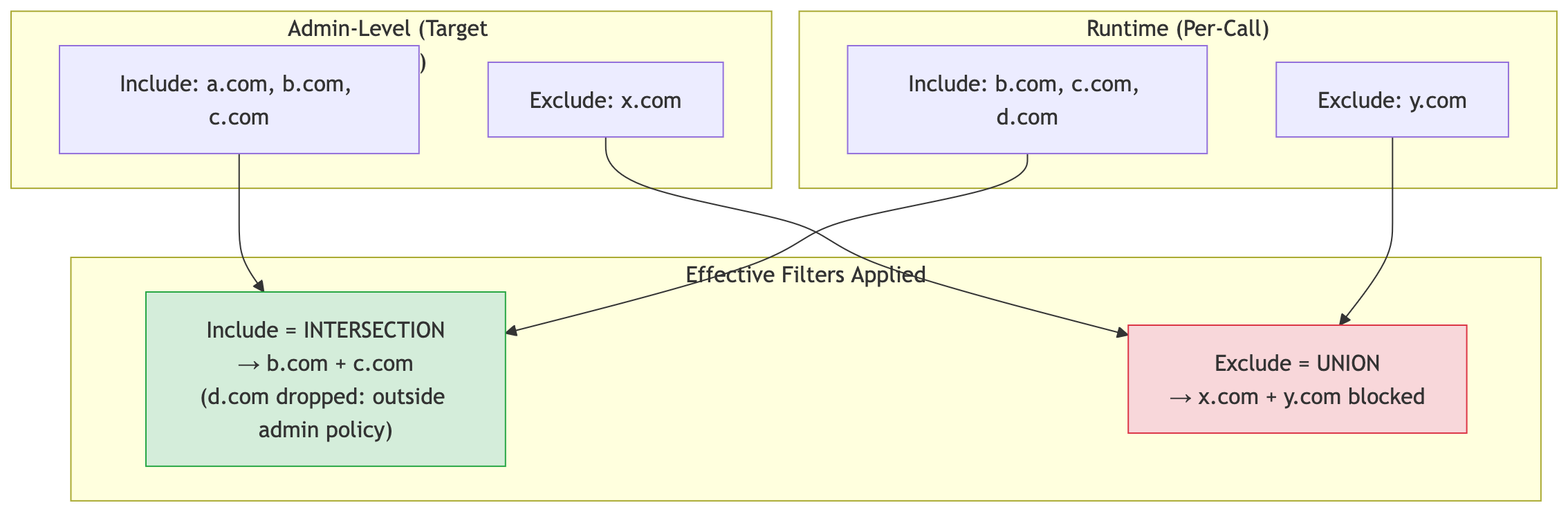
Figure 2: How admin and runtime domain lists merge, intersecting include lists and unioning exclude lists
Domain include (allowlist): The effective allowlist is the intersection of admin and runtime lists. If the admin allows [a.com, b.com, c.com] and the runtime call includes [b.com, c.com, d.com], only b.com and c.com are searched. The domain d.com is outside the admin domain list and is silently dropped.
Domain exclude (denylist): The effective denylist is the union of admin and runtime lists. If the admin blocks [x.com] and the runtime call excludes [y.com], both are blocked.
Note: A runtime caller can’t search a domain the admin hasn’t allowed and can’t unblock a domain the admin has denied. Runtime filters can only further restrict the search space.
Filter compliance behavior
When filters are active, Web Search prioritizes precision over recall. Results that can’t be verified against your filter criteria are excluded rather than returned unfiltered:
- Domain filter active: Results without a recognizable domain are excluded from consideration.
- Date filter active: Results without a recognized publication date are excluded.
You might receive fewer results when filters are active, but every result you do receive satisfies your specified filter criteria.
Cap enforcement
There are four lists: admin include, admin exclude, runtime include, and runtime exclude. Each supports up to 100 entries independently. For full configuration details and composition rules, see Configure domain filtering in the Developer Guide.
Getting started
Web Search is delivered through AgentCore Gateway, a capability of Amazon Bedrock AgentCore that provides a managed endpoint, compatible with the Model Context Protocol (MCP), for connecting agents to tools. Follow these steps to enable runtime domain and date filtering for your Web Search target.
Prerequisites
- An Amazon Bedrock AgentCore Gateway with a Web Search target pinned to connector version 1.2.0 or later.
- AWS Identity and Access Management (IAM) permissions: your calling agent or application needs
bedrock-agentcore:InvokeGatewayon the gateway Amazon Resource Name (ARN), and the Gateway’s service role needsbedrock-agentcore:InvokeWebSearch. See Configure the Gateway Service Role for the complete policy. - The latest AWS SDK (Python, JavaScript, Java, .NET, Go, Ruby, or PHP).
Step 1: Create a Web Search target with version 1.2.0
Use AWS SDK for Python (Boto3) to create (or update) a target pinned to version 1.2.0, with admin-level domain policies. If you already have a Web Search target on version 1.1.0, you can use UpdateGatewayTarget to pin it to version 1.2.0 instead of creating a new target. For additional setup options, including the AgentCore CLI and console, see Set up Web Search Tool.
Step 2: Invoke with runtime filters
Imagine your agent monitors SEC enforcement actions for a legal team. The team only trusts sec.gov as a primary source, and they need actions from the current month, not historical filings. Here’s the tools/call payload your agent sends:
The agent receives only results from sec.gov published in the last five weeks. There’s no third-party legal commentary or outdated filings in the results.
Note: The tool name in your tools/call request is the name discovered through tools/list, which follows the pattern web-search-filtered___WebSearch. The runtime include list (sec.gov) intersects with the admin list (approved-wire-1.com, approved-wire-2.com, sec.gov, investor.gov). Because sec.gov appears in both, it is searched. If you passed some-other-site.com, it would be silently dropped because it’s not in the admin allowlist.
Sample code examples
Here are some examples of how you can use the MCP client created from the AgentCore Gateway with the new filters at runtime. Code sample to create MCP client for calling tools
Example 1: Clinical research assistant with regulatory citation requirements
You’re building a research assistant for a pharmaceutical company’s regulatory affairs team. Company policy mandates that every answer cite only FDA, NIH, or ClinicalTrials.gov. A citation from a health blog isn’t only a quality issue. It’s a compliance violation that could surface in an audit. The agent needs to enforce this on every search, regardless of what query the model constructs.
Every result your agent cites is now verifiably from an approved regulatory source. Even if a WebMD article ranks #1 for the query, it never enters the model’s context window.
Example 2: Stock-update agent, only this week’s coverage
Your trading desk runs an agent that generates stock updates throughout the trading day. The problem: when a trader asks “what’s the latest on semiconductor stocks?”, the agent used to surface a highly-ranked analysis from last quarter, and a trader who acts on stale coverage loses money. You need every result to be from the past 7 days, no exceptions.
The agent’s stock updates now draw only on coverage published in the last seven days. That highly-ranked analysis from last quarter? It never reaches the model, so it can never mislead a trader.
Note: Results without a recognized publication date are excluded when the date filter is active. This ensures every returned result is verifiably within your time window.
Example 3: Investor-relations compliance, primary sources, current quarter only
Your investor-relations team uses an agent to prepare earnings analysis drafts. Two hard rules: (1) only primary sources: SEC filings and official investor pages: never crowdsourced financial commentary sites, and (2) only publications from this quarter, because citing last quarter’s numbers in a current-quarter analysis is a material error. You need both constraints enforced simultaneously on every search.
The agent’s draft now cites only official filings and wire reports from Q2 and Q3 2026. Crowdsourced commentary and opinion pieces are blocked even if they match the query perfectly. Anything from prior quarters is excluded regardless of source.
Example 4: SaaS platform with per-tenant source policies
You operate a research-agent SaaS platform serving healthcare, legal, and financial-services customers. Each tenant has contractually agreed source policies. Your healthcare customer’s Business Associate Agreement (BAA) requires citations from PubMed, CDC, and approved medical research databases only. Your legal customer insists on Cornell LII and official court records. Your finance customer mandates SEC, the Federal Reserve, and approved wire services. You can’t spin up a separate gateway target per tenant (you have 200 tenants and counting), so you apply tenant-specific filters at runtime using the Strands Agents SDK.
One gateway target serves 200 tenants, each with their own source policy, enforced dynamically at call time. Your healthcare tenant’s agent will never cite Reddit or WebMD, and your finance tenant’s agent will never cite a blog post, even though they share the same underlying infrastructure.
Important: System-prompt-based filtering (as shown earlier) relies on the agent following instructions. It isn’t hard enforcement. For hard enforcement, configure allowed domains at the target level (admin include list). Runtime filters passed directly in the tools/call payload provide API-level enforcement that cannot be bypassed by the model.
Input schema reference
The filters object introduced in connector version 1.2.0 adds domainFilter (include/exclude lists, up to 100 domains each) and publishedDateFilter (inclusive ISO-8601 UTC bounds) alongside the existing query and maxResults fields. For the complete input schema and field-by-field reference, see Input schema in the Amazon Bedrock AgentCore Developer Guide.
Availability and zero data egress
Runtime domain and date filtering is available today in the US East (N. Virginia) (us-east-1), Europe (Ireland) (eu-west-1), and Asia Pacific (Tokyo) (ap-northeast-1) Regions for Web Search on Amazon Bedrock AgentCore.
Web Search benefits from the zero data egress architecture of AgentCore: search queries are served entirely within AWS infrastructure. Customer queries are not sent to a third-party search engine or routed outside AWS. For organizations in regulated industries, such as financial services, healthcare, and government, this removes an entire category of compliance review.
Backward compatibility
These features are fully backward compatible:
- No breaking changes. Version 1.2.0 is a minor release. The new fields are additive and the filters object is optional. Existing API calls without filters continue to work exactly as before.
- SDK support. Available across AWS SDKs (Python (Boto3), JavaScript/TypeScript, Java, .NET, Go, Ruby, and PHP SDKs), AWS Command Line Interface (AWS CLI) and AgentCore CLI.
- Console support. The AWS Console for AgentCore Web Search targets now surfaces both include and exclude domain-list inputs in the connector configuration UI.
Conclusion
Runtime domain and published-date filtering give developers building on Amazon Bedrock AgentCore Gateway the per-call precision they need to build trustworthy, policy-compliant agents without sacrificing the simplicity of a managed, server-side search tool.
Whether you’re restricting an agent to approved regulatory sources, scoping results to the last 24 hours, or dynamically applying tenant-specific policies, Web Search on AgentCore keeps you in control with zero data egress, IAM-native authentication, and no external dependencies.
These features are available today in US East (N. Virginia) (us-east-1), Europe (Ireland) (eu-west-1), and Asia Pacific (Tokyo) (ap-northeast-1) AWS Regions for Web Search on Amazon Bedrock AgentCore.
Get started today:
About the authors


